THE INGREDIENTS · EXPLAINED
Know your balm.
Know your ingredients.
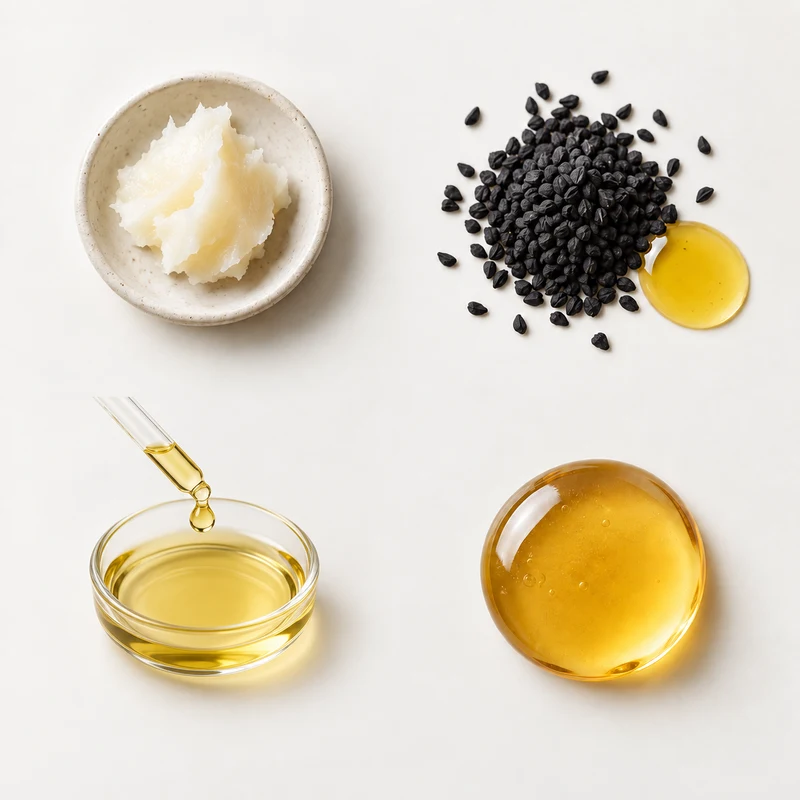
Organic tallow. Black seed oil. Jojoba. Vitamin E. A rich base, two botanical oils and an antioxidant, each with a different job.
What is in evernoure’s tallow balm?
Tallow provides the rich base, black seed oil is our signature botanical pairing, jojoba helps the blend spread, and vitamin E helps protect the oils from oxidation. These are the four ingredients we introduce below. The complete label will also identify any carrier ingredients supplied with them, before orders open.
01 · THE RICH BASE
Organic tallow
Rendered beef fat · Animal-derived
Tallow gives a balm its rich, substantial base. In our blend, it is the foundation the other oils soften and complement.
Rendering separates fat from the surrounding tissue. Tallow contains a mixture of fatty acids, including oleic, palmitic and stearic acids. That composition helps explain its texture; it does not make tallow identical to human skin or establish that it works better than other moisturising ingredients.
What does the research say?
A 2024 scoping review found substantial gaps in the evidence for topical tallow. Its included studies varied in their methods and relevance to everyday skincare. It is a useful overview, but not proof that a tallow balm treats skin conditions or outperforms a well-formulated cream. Read the tallow review [1].
For a rich balm texture. “Organic” describes our tallow ingredient; it should not be read as certification of the complete finished balm. Find more about our approach on the sourcing page.
02 · OUR SIGNATURE PAIRING
Black seed oil
Nigella sativa · Botanical seed oil
Black seed oil is pressed from Nigella sativa seeds. It contributes a different botanical oil to the tallow base, with a distinctive natural aroma.
It is also called black cumin oil, although common names can be ambiguous. The botanical name matters when comparing products: look for Nigella sativa, rather than assuming that every oil labelled “cumin” is the same ingredient.
Promising research is not a finished-product claim
A randomised trial compared a topical Nigella preparation with two other treatments for hand eczema over four weeks. It studied a particular preparation and clinical setting—not our balm. Those findings cannot establish that a tallow and black seed blend treats eczema. Read the human study [2].
Allergic contact dermatitis after topical black seed oil use has also been reported. A case report shows that a reaction is possible; it does not tell us how commonly it happens. Natural ingredients are not automatically suitable for everyone. See the published case report [3].
As the signature botanical partner in our oil blend. We do not use ingredient research to promise that the finished balm will treat acne, eczema or another skin condition.
03 · TEXTURE & SPREAD
Jojoba oil
Simmondsia chinensis · Liquid wax
Despite its everyday name, jojoba oil is a liquid wax. We use it to soften the feel of the tallow blend and help it spread.
A balm has to work as a complete formula. The proportion of jojoba affects how readily the blend moves across the skin; the final feel also depends on the tallow, other oils, temperature and manufacturing process. An ingredient’s reputation alone cannot predict whether a particular balm will feel light or greasy.
Human measurements and laboratory results are different evidence
A human skin study using Raman microspectroscopy examined changes in water bonding after applying materials including jojoba. This offers a closer look at what happens in the outer skin layer, rather than proof of long-term clinical benefits. Read the human skin study [4].
Jojoba has also been investigated in laboratory skin-cell research related to wound healing. Cells in a laboratory are not the same as people using a face balm. We do not turn that study into a wound-healing claim for evernoure. Read the laboratory study [5].
For spread and texture. Whether you enjoy the finished feel is more useful than broad claims that one oil is “perfect” for every skin type.
04 · PROTECTING THE OILS
Vitamin E
Tocopherols · Antioxidant
Vitamin E helps protect the oils from oxidation. Its main role here is looking after the blend—not promising scar removal or skin regeneration.
Tocopherols are forms of vitamin E used as antioxidants. Experimental research in vegetable oils shows that their type, relative amounts and concentration affect oxidative stability. Simply adding more is not a reliable route to a better formula, and an oil study cannot establish our balm’s shelf life. Read the oxidation study [6].
Antioxidant does not mean preservative
Oxidation and microbial contamination are different problems. Vitamin E is not a substitute for an appropriate microbiological safety strategy, a safety assessment or finished-product stability work.
Vitamin E materials can contain a carrier oil. The complete ingredient declaration must reflect the material actually used. A four-ingredient headline should never hide additional components in the finished formula.
Ingredient illustrations are shared with our homepage; they are not photographs of supplier batches.
CHOOSING A TEXTURE
Is a tallow balm better than a cream?
There is no universal winner. Richer products and lighter creams feel different, and personal preference matters. The NHS describes ointments as greasier than creams and notes that finding a suitable emollient can involve trying different products. That guidance helps explain texture choices; it is not an endorsement of our balm. NHS emollient guidance [7].
A balm may appeal if…
You enjoy a richer, oil-based texture and want to use a small amount where that feel suits you. Follow the finished product’s directions for application.
A cream may appeal if…
You prefer a lighter texture for your routine. Choosing a cream does not mean accepting inferior skincare: formulation and suitability matter more than the category name.
THE EVIDENCE, AT A GLANCE
Ingredient evidence is a starting point.
These studies ask different questions. None is a clinical trial of the finished evernoure balm, and we have not published such a trial.
Swipe the table to compare all columns →
| Ingredient | Evidence discussed | What remains unproven here |
|---|---|---|
| Tallow | A scoping review with evidence gaps. | Superiority over other moisturisers. |
| Black seed oil | A short clinical trial; reaction reports. | Treatment benefits or universal suitability for our blend. |
| Jojoba | Human skin measurements and cell research. | Clinical skin repair from this balm. |
| Vitamin E | Oil oxidation experiments. | Our finished shelf life or microbial safety. |
BEYOND THE FRONT OF THE JAR
How to read a balm’s ingredient list.
The front label introduces a product. The complete ingredient list tells you what is in it, using standard cosmetic ingredient names, often called INCI names.
- Read the full list. Check for carrier oils and any fragrance components, as well as the ingredients featured in the headline.
- Ask what “organic” describes. An organic ingredient and a certified organic finished product are different claims.
- Keep sourcing and suitability separate. Knowing where an ingredient comes from is useful. It does not establish that it will suit your skin.
- Look beyond ingredients. Responsible-business details, batch identification, durability information and precautions are also part of the product information. Great Britain requires a cosmetic safety assessment; Northern Ireland has a separate regulatory route. Read the official guidance [8].
We will provide the complete ingredient declaration, net contents and directions before orders open. See our launch and delivery information for the current ordering position.
STRAIGHT ANSWERS
Your ingredient questions.
Is tallow skincare vegan?
No. Beef tallow is animal-derived. “Cruelty-free” and “vegan” describe different things; one should not be used as a substitute for the other. Read our sourcing information.
Are black seed oil and black cumin oil the same?
Black cumin is a common name used for Nigella sativa, but common names can vary. Check the botanical identity on the product or supplier documentation. Our ingredient is Nigella sativa seed oil.
Will this balm treat eczema or acne?
We do not make that claim. Research on an individual ingredient does not establish a treatment effect for our finished formula. A pharmacist or qualified clinician can advise on a skin condition and suitable treatment.
Can a rich balm clog pores?
We have not established that our balm is non-comedogenic. The NHS notes that some emollients can cause blocked or inflamed follicles or aggravate acne. Individual response matters; stop using a product that irritates your skin. See NHS guidance [7].
Does natural mean fragrance-free?
No. Ingredients can have their own aroma, and “natural” does not tell you whether fragrance has been added. Black seed oil has a noticeable natural smell. Confirm the complete label and fragrance information before purchasing.
How should I keep a balm jar clean?
Use a clean spatula rather than fingers when taking emollient from a pot. Keep the lid closed and follow the label. Emollient residue on fabrics increases fire risk: keep away from flames and cigarettes. Read the NHS safety advice [7].
FOLLOW THE EVIDENCE
Sources & further reading.
This is an ingredient guide from evernoure, not an independent clinical review. Links below let you examine the original research and official guidance.
- Tallow, Rendered Animal Fat, and Its Biocompatibility With Skin: A Scoping Review (2024). Review of a limited, varied evidence base.
- Comparison of therapeutic effect of topical Nigella with Betamethasone and Eucerin in hand eczema (2013). Randomised clinical trial of a specific topical preparation.
- Allergic contact dermatitis from black cumin (Nigella sativa) oil after topical use (1997). Case report.
- Stratum corneum occlusion induces water transformation towards lower bonding state (2020). Human skin measurements using Raman microspectroscopy.
- Wound healing properties of jojoba liquid wax: an in vitro study (2011). Laboratory cell research.
- Contribution of the Ratio of Tocopherol Homologs to the Oxidative Stability of Commercial Vegetable Oils (2018). Experimental oil stability research.
- NHS: Emollients. Texture, use and safety guidance.
- GOV.UK: Making cosmetic products available to consumers in Great Britain. Safety and labelling requirements.
ANCIENT SKINCARE
Meet your everyday balm.
Explore the blend, compare packs and get to know evernoure.
Explore the balm →How we choose our ingredients